CAD to Web · 3D Viewer
3D Product Configurator Examples: 14 Real Builds by Industry
By Gauri Nimbalkar · 17 November 2026
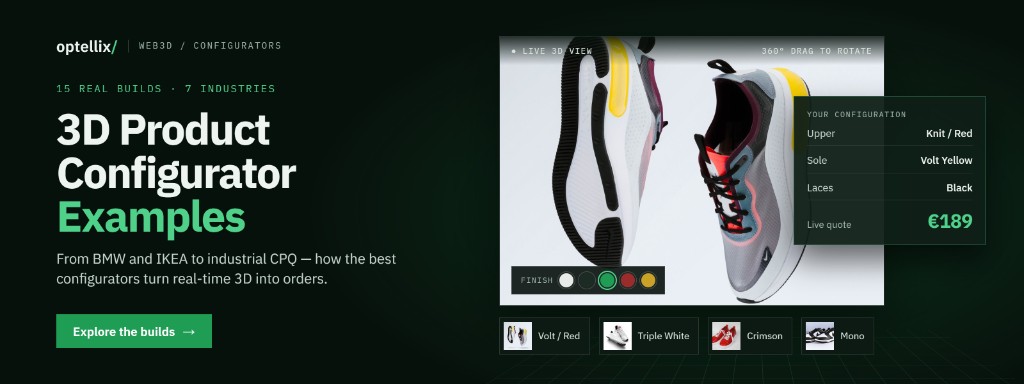
Most "3D product configurator examples" galleries stop at sofas and sports cars. Many also count AR makeup try-ons and photo flipbooks as if they were the same class of product. That leaves product owners with a long brand list and no transferable pattern for their own catalog, rules, or ERP.
A 3D product configurator lets a buyer change options on a live 3D model and push that choice into price, quote, BOM, or order. This post is a proof gallery: fourteen named production builds, selected against a strict bar, with the pattern each vertical actually needs.
Key Takeaways
- A build counts here only if it has real-time 3D, a named production use, and a configuration-to-outcome path (price, quote, BOM, order, or ERP build sheet). Two Optellix entries are disclosed exceptions to the last gate.
- B2C furniture and fashion optimize for conversion; industrial CPQ optimizes for quote cycle time and manufacturable BOMs. Same UI metaphor, different success metric.
- Modular configurators in the 3D Cloud 3D Commerce Index Q2 2026 posted a 16% add-to-cart rate and 2.2% purchase conversion across 40+ retailers representing over $10 billion in annual 3D commerce sales. Treat this as category context, not a target.
- Match your industry to a pattern (material swaps, modular layout, parametric CAD, ERP rules, or world-anchored geometry) before you shop platforms or RFPs.
- Two Optellix builds are disclosed as first-party work (a commercial solar design platform and an urban bus-stop planner). The other twelve are public brands or documented third-party case studies.
How we picked these 14 (and what we rejected)
Strict criteria beat longer vendor lists. Every entry had to clear all three gates:
- Real-time 3D. The buyer changes options on a live 3D model rendered in the browser (WebGL or WebGPU), streamed from a game engine, or rendered on demand from a 3D master model. Where the source discloses how the 3D is delivered, we say so.
- Named production use. A live brand site, documented case study, or disclosed Optellix portfolio build.
- Configuration → outcome. Options change the model and feed price, quote, BOM, order, or an ERP build sheet.
We rejected pure AR try-on, 360 spins with no options, and static PDP galleries. Agency demos appear only when labelled as demos or when a named production deployment is documented alongside them. Two Optellix entries (13 and 14) do not produce a price or BOM; we flag that where they appear. This is an editorial survey, not a ranked "best of."
Automotive — from showroom theater to factory build sheets
Automotive configurators win when the configuration lands in a factory build sheet, not only on a marketing page. At the high end, market rules lock illegal specs before the order leaves the tool.
1. BMW configurator (new 3D mode)
BMW's current configurator includes an immersive 3D visualizer built with rendering technology from the gaming industry (BMW Group Designworks case study, retrieved 2026-10-12). Individual paint finishes, which used to live on a separate visualizer site, can now be chosen directly in the main configurator in European markets (BMW Blog).
Rendering: real-time 3D visualizer. Pattern: high option count + brand-controlled finishes. Best for: OEM retail journeys where paint and trim accuracy matter more than modular layout.
2. Koenigsegg Jesko (Loop Studio)
Loop Studio's WebGL Jesko configurator is embedded as an iframe inside Koenigsegg's ERP and used in actual production decisions. Exterior paint, interior stitching, wheels, targa roof, dihedral doors, and the G-Force package update a production build sheet. US and European homologation rules lock or unlock options by market so illegal specs never leave the tool (Loop Studio).
Pattern: rules + ERP build sheet. Best for: low-volume, high-constraint vehicles where a wrong combo is a factory problem, not a return label.
3. Maserati Experience Engine (Accenture)
Accenture and Maserati built a cinematic configurator on Unreal Engine that renders on demand from a 3D master model instead of using a library of pre-produced images. A configuration started on maserati.com can be saved and resumed in a dealership. At Fuoriserie scale, pre-rendered asset libraries become unsustainable; generating from a 3D master model is the architectural fix (Accenture case study).
Rendering: Unreal Engine, rendered on demand. Pattern: render-on-demand + retail continuity. Best for: luxury OEMs that need one configuration record across web and showroom.
Automotive pattern callout: When SKU explosion meets regulatory rules, the configurator stops being a conversion widget and becomes production infrastructure. If your success metric is still "time on page," you are measuring the wrong thing.
Furniture and home — modular layouts and fabric scale
Furniture is where most public example lists live, and where modular commerce metrics are strongest.
4. IKEA
IKEA's visual tools let shoppers configure sofas, cabinets, kitchens, and wardrobes by color, material, and layout. The design goal is mass-market clarity: enough fidelity to decide, not a photoreal showroom for every fabric SKU. That simplicity is why it appears in almost every competitor roundup (Vividworks summary, updated 2026-07-15).
Pattern: modular / consumer. Best for: high-traffic catalogs where UX friction kills more revenue than missing PBR does.
5. Marlowe & Finch (VisionThree)
VisionThree shipped a real-time modular sofa configurator for Marlowe & Finch with 400+ upholstery fabrics, snap-to-grid modules, live pricing, Shopify Plus checkout, and AR preview. The vendor case study reports higher online conversion and average order value after launch (VisionThree — vendor-reported, not independently audited).
Pattern: modular + fabrics + commerce. Best for: premium upholstery brands drowning in photography variants.
6. Flexsteel (3D Cloud)
Flexsteel centralized product visualization for a 1,300+ dealer network and deployed 400+ configurators across consumer and dealer channels in under a year. The reported operating model is one non-technical marketing specialist managing tens of thousands of monthly sessions with roughly three-minute average session time (3D Cloud case study).
Pattern: dealer-scale catalog 3D. Best for: manufacturers who sell through dealers and cannot ship a unique 3D stack per retailer.
In Q2 2026, modular configurators in the 3D Cloud Index posted a 16% add-to-cart rate and a 2.2% purchase conversion rate (3D Cloud 3D Commerce Index Q2 2026). Treat that as category context rather than a target: it comes from one vendor's index, and how sessions are counted changes what you can fairly compare it with. It is still a better reference than the unsourced "40–90% uplift" claims that circulate on vendor blogs.
Fashion and footwear — guided customization at luxury speed
Fashion and footwear configurators win on guided material and color choices at brand-safe speed. The hard constraint is what the brand will produce, not engineering homologation.
7. Prada America's Cup sneaker (Accenture)
Prada and Accenture launched a 3D web configurator for the America's Cup sneaker in about four months, followed by an in-store version. A digital twin carries size, shape, materials, and colors, and a rendering server generates high-resolution images of each custom build on demand. The same architecture was later extended to the Galleria handbag (Accenture).
Rendering: server-rendered on demand from a 3D master model. Pattern: digital twin + render server. Best for: luxury brands where load time and material fidelity are brand requirements, not engineering nice-to-haves.
Also notable (not counted in the fourteen): Nike By You is the best-known consumer reference for shoe customization, from picking a shoe type through ordering, with in-store versions at select Nike locations (nike.com, retrieved 2026-10-12). We list it for context rather than counting it, because we could not confirm from public sources how its 3D is delivered. Adidas Uniforms and The Line Up's Cocoon-built apparel configurator across 1,200+ garments are also useful adjacent references if apparel is your lane.
Jewelry and instruments — high consideration, low polygon drama
High-consideration SKUs need option clarity more than polygon drama. Buyers compare structural choices; they do not need room-scale AR.
8. Brilliant Earth
Brilliant Earth's engagement-ring flow lets shoppers configure diamond shape, quality, and setting with a visual product configurator rather than a static matrix of photos (3D Cloud examples roundup, retrieved 2026-10-08). Trust and option clarity matter more than room-scale AR.
Pattern: option-tree visual config. Best for: high-consideration SKUs where buyers need to compare structural choices, not fabric swatches.
9. Fender Mod Shop
Fender Mod Shop lets players configure body shape, color, pickguard, hardware, and pickups on iconic models. The interaction is closer to a constrained bill of materials than a room planner, which is exactly right for instruments (Vividworks).
Pattern: option-tree visual config. Best for: products where accessory compatibility is the hard problem and polygon count is not.
Industrial and B2B CPQ — where the SERP is thin
This is the section most consumer-facing example galleries skip. Industrial success is rarely "conversion uplift on a PDP." It is self-serve volume, quote speed, and a BOM that manufacturing can build.
10. Piab Customer Self-Service (Tacton)
Piab's modular vacuum systems run through a Tacton-powered self-service platform with ERP-linked pricing, availability, and item creation. The published operating scale: 40,000+ self-service configuration sessions per month and 58,000+ configured products in ERP, with 3D visualization added in 2024 (Tacton success story, retrieved 2026-10-08).
Pattern: ERP-linked modular CPQ. Best for: component manufacturers whose catalog is combinatorial by design.
11. Plantec Maschinen roller conveyors (Konfigear)
Plantec's industrial roller-conveyor configurator delivers real-time 3D layout, automated BOM and pricing, and instant quotes for customized conveyor systems (Konfigear case study). The sales motion is engineer-to-order without the email ping-pong that usually accompanies it.
Pattern: 3D CPQ + BOM/quote. Best for: machine builders quoting layouts, not fashion SKUs.
12. asecos safety cabinets (4PACE)
asecos maps hazardous-materials storage cabinets from product finder through guided configuration to production drawings and BOMs. 4PACE reports the data-driven process can save up to two days on internal coordination loops. Those loops used to span multiple departments (4PACE project story, retrieved 2026-10-08).
Pattern: config → drawings + BOM. Best for: regulated products where a wrong shelf spacing is a compliance problem.
Also notable: WEG's gear-unit configuration platform (4PACE) and Vagen's screw-conveyor configurator that runs Autodesk Inventor Design Automation and returns STEP, Inventor, and PDF files.
Energy, solar, and spatial planning — geometry from the world, not a catalog
These two entries are Optellix first-party work, disclosed per our editorial rules. They are the exception to Gate 3: neither produces a price or BOM. We include them because the pattern is almost invisible on consumer example lists: the geometry does not start as an artist SKU.
13. Commercial solar design platform (Optellix)
A commercial solar design client needed browser-based design: roof planes from noisy DSM data, panel placement, and sun and shadow simulation, so sales, engineering, and customers could work from one shared visual model. Optellix built plane-fitting algorithms, a virtual sun engine, and a Three.js / WebGL interactive environment (Optellix case study).
Pattern: world-anchored geometry. Best for: site-specific design where the "product" is a layout on a real roof, not a catalog sofa.
14. Urban bus-stop planning configurator (Optellix)
For urban planning, Optellix built a 3D configurator with real-time editing and Google Maps / Street View integration. Non-technical stakeholders could place and preview community infrastructure in context (Optellix industries).
Pattern: maps-anchored layout. Best for: civic and site tools where GIS context is the product, not optional chrome.
Spatial pattern callout: If your input is DSM, survey mesh, or a map tile, not a clean glTF catalog, most furniture SaaS importers will fail Gate 0 (can your source geometry reach a browser at all?) in how to scope a configurator build. That is an architecture fact, not a vendor preference.
Which pattern fits your industry?
Match the pattern before you shop platforms or write an RFP. WebGL 2 remains the default delivery surface for commercial browser builds, with about 95.73% browser support globally (caniuse, Sep 2026). WebGPU is a growing second path.
| Pattern | Typical industries | What must work |
|---|---|---|
| Material / finish swaps | Fashion, jewelry, simple furniture | Fast material maps, brand color accuracy |
| Modular layout | Sofas, shelving, fixtures | Snap rules, live dimensions, dealer share |
| Parametric CAD → files | Conveyors, machines, ETO | Server-side CAD or validated geometry + STEP/PDF |
| Rules + ERP build sheet | Automotive specialty, industrial CPQ | Homologation/compat rules, BOM, pricing |
| World-anchored geometry | Solar, urban, site design | GIS/DSM/maps + simulation, not catalog SKUs |
If you are past pattern recognition and into budget and timeline, see how much a configurator costs to build. For manufacturing sales patterns, use the real-time manufacturing playbook.
Frequently Asked Questions
What are examples of 3D product configurators?
Production examples span BMW and Koenigsegg in automotive, IKEA and Marlowe & Finch in furniture, Prada in fashion, Piab and Plantec in industrial CPQ, and a commercial solar design platform built by Optellix. The common thread is real-time 3D plus a path from options to price, quote, BOM, or order. That is not a static gallery.
Are 3D product configurators only for furniture and cars?
No. Industrial CPQ (Piab's 40,000+ monthly self-serve sessions) and solar/site tools are production-grade. Consumer roundups under-represent them because vendor SEO content skews toward ecommerce keywords.
What is the difference between a 3D viewer and a 3D configurator?
A viewer displays a model. A configurator changes options and outputs a commercial or manufacturing artifact. For the viewer side of that split, see what a browser-based CAD viewer is.
Do 3D configurators increase conversion?
The evidence is mixed and depends on what is measured. One published A/B test (GANT/Fibbl, 274 products, 13 markets, 400,000+ users, May–October 2024) found a 6.3% conversion uplift for a 3D-first product page versus image-first, significant at 95% (Fibbl / GANT). That test compares a 3D viewer with images, not a full configurator. Modular commerce benchmarks from 3D Cloud (16% add-to-cart, 2.2% purchase) are useful category context but measure something different. Skip unsourced "40–90%" claims and platform self-reports without methodology.
Conclusion
Fourteen builds are only useful if they teach a transferable pattern. Use the inclusion criteria to reject fake-3D. Use the industry sections to see what already ships. Use the pattern matrix to locate your catalog before you debate SaaS versus custom.
B2C teams should watch conversion and AOV. B2B industrial teams should watch quote cycle time, BOM correctness, and ERP truth. If your geometry is CAD- or site-derived, start with scoping, not a furniture platform demo.
Next step: how much a configurator costs to build. If you want a build partner on WebGL and CPQ integration, see WebGL configurator development services.